Proxy management
A VpnHood client can optionally put its tunnel inside a proxy: it reaches its server through a SOCKS4, SOCKS5 or HTTP(S) proxy instead of going straight to it. The proxy only relays the encrypted tunnel and cannot see inside. These packages give the client one proxy, or a managed list of endpoints that are rated and rotated, kept in a store and updated from a URL.
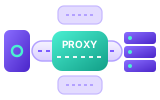
What goes through the proxy
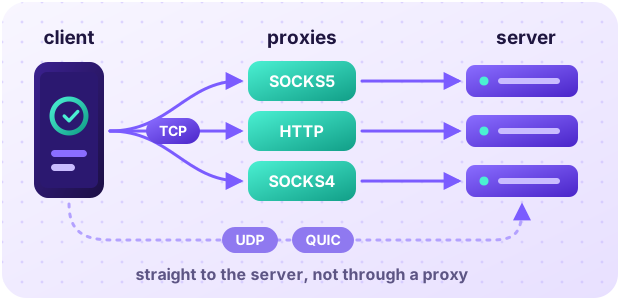
Every TCP connection the client makes to its server goes through a proxy: its requests and the TCP channels of its tunnel. Each connection can take a different proxy of the list.
The UDP channel and QUIC go straight to the server's address, not through a proxy. When the server can be reached only through a proxy, keep the tunnel on TCP, the default.
When to use it
- A network blocks your server's address: the client puts its tunnel inside a proxy and reaches the server through it.
- You keep a list of proxies up to date from a URL, and the client uses the best of them.
Which package to take
- Core.Proxies.Management: the connectors.
- Core.Proxies.Management.Abstractions: the connector's contract, proxy endpoints and their parsing, and the list's store.
- Core.Proxies.Management.Sqlite: a shared endpoint store in SQLite.
Its packages
| Package | What it does | |
|---|---|---|
| VpnHood.Core.Proxies.Management | VpnHood connectors through proxies: one given proxy, or a managed, rated list. | Overview · API |
| VpnHood.Core.Proxies.Management.Abstractions | How a VpnHood client connects through proxies: the proxy connector, proxy endpoints and their parsing, and the managed list's store and its updates from a URL. | Overview · API |
| VpnHood.Core.Proxies.Management.Sqlite | SQLite-backed shared proxy endpoint store for VpnHood endpoint management. | Overview · API |